|
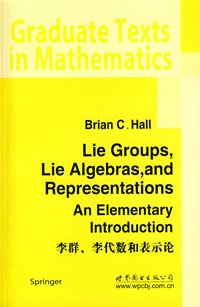
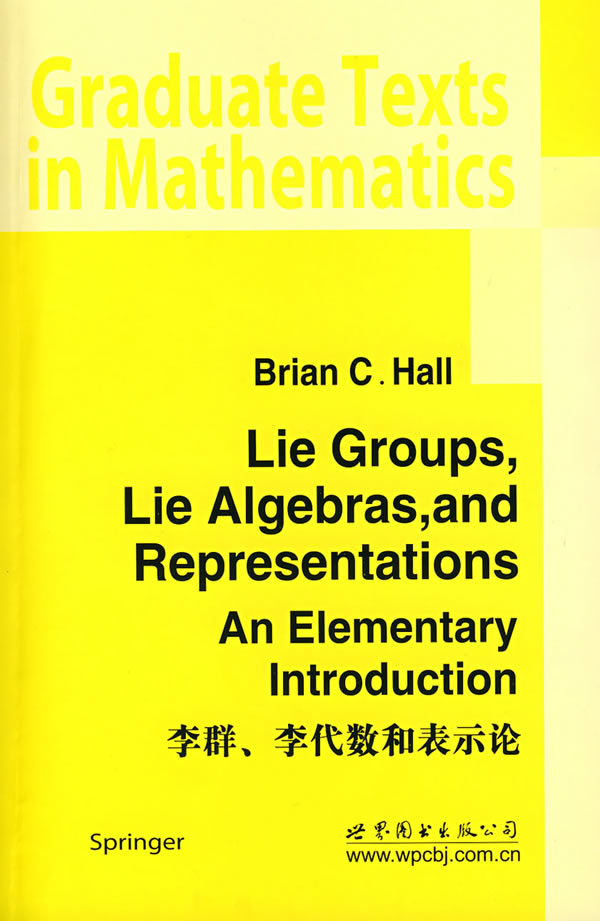
| 李群、李代數和表示論 |
|
| |
| (查找更多有關 (美)布賴恩 著 的資訊) |
 |
◆基本信息◆ |
| 書號:9787506282970 |
作者:(美)布賴恩 著 |
| 開本: |
裝幀: |
| 出版日期:2007-10-1 |
出版社:世界圖書出版公司 |
圖書類型:  |
字數: |
| ---------------------------------------------------------------------------------------------- |
| ◆馬上購買◆ |
 四眼仔網上書城 四眼仔網上書城
|
 |
四眼仔網上書城定價:
US$10.66
|
|
|
|
|
|
|
| ◆內容介紹◆ |
Part I General Theory
Matrix Lie Groups
1.1 Definition of a Matrix Lie Group
1.1.1 Counterexa~ples
1.2 Examples of Matrix Lie Groups
1.2.1 The general linear groups GL(n;R) and GL(n;C)
1.2.2 The special linear groups SL(n; R) and SL(n; C)
1.2.3 The orthogonal and special orthogonal groups, O(n) and SO(n)
1.2.4 The unitary and special unitary groups, U(n) and SU(n)
1.2.5 The complex orthogonal groups, O(n; C) and SO(n; C)
1.2.6 The generalized orthogonal and Lorentz groups
1.2.7 The symplectic groups Sp(n; R), Sp(n;C), and $p(n)
1.2.8 The Heisenberg group H .
1.2.9 The groups R, C*, S1, and Rn
1.2.10 The Euclidean and Poincaxd groups E(n) and P(n; 1)
1.3 Compactness
1.3.1 Examples of compact groups
1.3.2 Examples of noncompa groups
1.4 Connectedness
1.5 Simple Connectedness
1.6 Homomorpliisms and Isomorphisms
1.6.1 Example: SU(2) and S0(3)
1.7 The Polar Decomposition for S[(n; R) and SL(n; C)
1.8 Lie Groups
1.9 Exercises
2 Lie Algebras and the Exponential Mapping
2.1 The Matrix Exponential
2.2 Computing the Exponential of a Matrix
2.2.1 Case 1: X is diagonalizable
2.2.2 Case 2: X is nilpotent
2.2.3 Case 3: X arbitrary
2.3 The Matrix Logarithm
2.4 Further Properties of the Matrix Exponential
2.5 The Lie Algebra of a Matrix Lie Group
2.5.1 Physicists' Convention
2.5.2 The general linear groups
2.5.3 The special linear groups
2.5.4 The unitary groups
2.5.5 The orthogonal groups
2.5.6 The generalized orthogonal groups
2.5.7 The symplectic groups
2.5.8 The Heisenberg group
2.5.9 The Euclidean and Poincar6 groups
2.6 Properties of the Lie Algebra
2.7 The Exponential Mapping
2.8 Lie Algebras
2.8.1 Structure constants
2.8.2 Direct sums
2.9 The Complexification of a Real Lie Algebra
2.10 Exercises
3 The Baker-Campbell-Hausdorff Formula
3.1 The Baker-Campbell-Hausdorff Formula for the Heisenberg Group
3.2 The General Baker-Campbell-Hausdorff Formula
3.3 The Derivative of the Exponential Mapping
3.4 Proof of the Baker-Campbell-Hausdorff Formula
3.5 The Series Form of the Baker-Campbell-Hausdorff Formula
3.6 Group Versus Lie Algebra Homomorphisms
3.7 Covering Groups
3.8 Subgroups and Subalgebras
3.9 Exercises
4 Basic Representation Theory
4.1 Representations
4.2 Why Study Representations?
4.3 Examples of Representations
4.3.1 The standard representation
4.3.2 The trivial representation
4.3.3 The adjoint representation
4.3.4 Some representations of S(,1(2)
4.3.5 Two unitary representations of S0(3)
4.3.6 A unitary representation of the reals
Part II Semistmple Theory
References
Index |
| --------------------------------------------------------------------------------------------------------------------------------------- |
| ◆圖書封面◆ |
|
|
|
|
|


 您的購物車有
0 本圖書
您的購物車有
0 本圖書



 我的帳戶
我的帳戶

